Publicado
29 September 2026
Transnational Connections: Anti-Gender Movements in Europe and the US
Escrito por: Jamie Vernaelde
Presentation slide
Imagen de Jamie Vernaelde (Ipas), Licencia private archive, entrusted to ReGA
Read the presentation by Jamie Vernaelde held at the ReGA Symposium on September 18, 2026. Vernaelde works at Ipas, a reproductive rights and gender justice organization. Based originally in the United States, Ipas has been working for around 50 years and in about 20 countries trying to advance access to contraception and abortion. Apart from reinforcing public sector politics, the organization has a small advocacy team that has been monitoring anti-gender and anti-rights for the past 15 to 20 years, focussing mainly on U.S. actors.
Why is sexual and reproductive health and rights (SRHR) the canary in the coal mine? Abortion and reproductive autonomy are among the first rights targeted when authoritarian politics advance — they're visible, emotionally mobilizing, and connected to deeply held beliefs about gender, family, and national identity. When SRHR is rolled back, it signals and enables broader democratic backsliding: shrinking civic space, captured courts, weakened institutions. There is an asymmetry at the core of the challenge: a well-funded, coordinated, transnational anti-gender infrastructure versus underfunded and often siloed feminist and pro-rights movements, separated from other topics as climate justice work, poverty justice work.
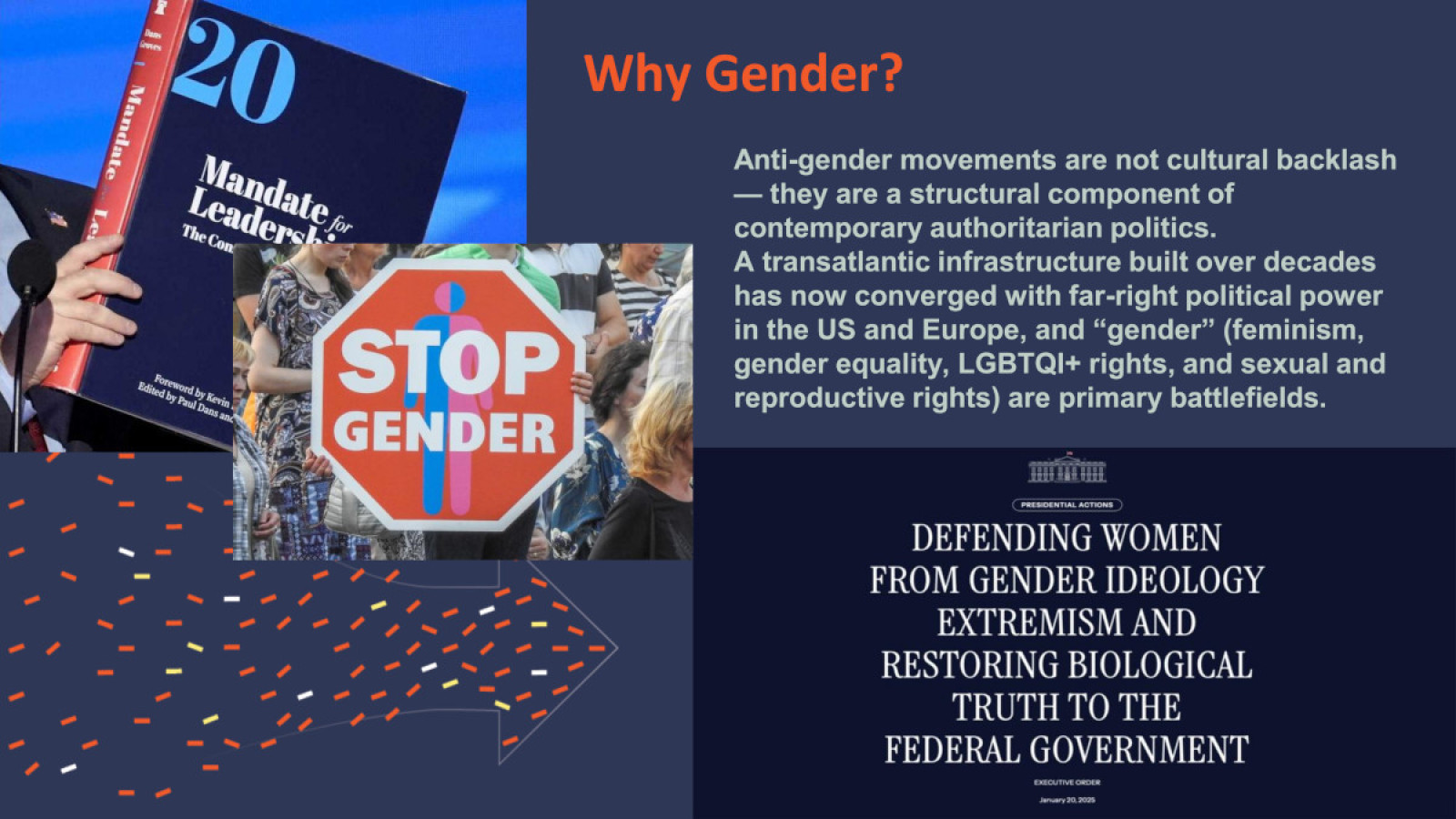
Why Gender?
Thesis: Anti-gender movements are not cultural backlash — they are a structural component of contemporary authoritarian politics. A transatlantic infrastructure built over two decades has now converged with far-right political power in the US and Europe, and sexual and reproductive rights are a primary battlefield.
Anti-gender politics works for authoritarianism: It creates an enemy. "Gender ideology“ as an explicitly anti-feminist and anti-LGBTQI+ term was created in 1985 by the Vatican, very much as a reaction to feminist organizing to the demand for LGBTQI+ rights. You have a term that was created in the 1980s that's now in US domestic and foreign policy, and that is perpetuated by far right politicians from France to Ecuador. It mobilizes voters emotionally, often creating moral panic, against an array of issues. “Anti-Gender Ideology” is now a feature in far-right rhetoric, from official policy to speeches to social media. It launders authoritarian politics in respectable language ("family," "free speech," "religious liberty," "sovereignty," "civilizational heritage") and attacks independent institutions — courts, election bodies, media regulators, UN mechanisms. It fractures progressive coalitions by forcing SRHR, LGBTQI+ rights, democracy, and anti-racism work into separate silos. Also, it provides a common ideological glue across disparate far-right movements (the concept scholars call the "symbolic glue" of anti-gender politics).
This is not about "gender" per se — it is about power. The resistance is "about power and maintaining or promoting social and political hierarchies in the face of their (perceived) decline.“ Which is where we also get conspiracy theories, like the anti-migrant Great Replacement or Remigration, anti-Muslim, in the UK it’s anti-South Asian, in the US we see anti-Latin American.
It also creates a bridge narrative – it is capable of being used across differences of different geopolitical actors, which is why it works very well in multilateral spaces, like at the United Nations. You have groups working together at the UN who might be from Muslim majority countries, the US government, and the Holy See who are all able to come to work together against specific issues because of this narrative that they have around gender ideology.
An example: Brian Brown
Brian Brown is not the subject of this talk — he is one node that reveals the system. He is useful in understanding how domestic US anti-LGBTQI+ organizing becomes transnational "pro-family" infrastructure, which then connects to far-right electoral politics and authoritarian agendas.
Brown is a U.S. anti-gender organizer whose significance lies in his role as a transnational connector: he was first affiliated with the US domestic anti-marriage equality group, the National Organization for Marriage. But then, through the International Organization for the Family (IOF) which hosts World Congresses of Families (WCF), as well as his work on the board of the Madrid-based CitizenGO, which is a sign-up organization that's very closely affiliated with the Vox Party, and his affiliation with the Political Network for Values, he links U.S. Christian-right infrastructure with European anti-rights, nationalist, and electoral networks.
This ecosystem also includes influential European elite figures such as Princess Gloria von Thurn und Taxis, a German Catholic traditionalist, anti-abortion campaigner, and speaker at Brown’s 2019 World Congress of Families event in Verona—a major gathering of anti-abortion, anti-LGBTQI+, religious-conservative, and far-right political actors. Her presence illustrates that these networks are not only grassroots or party-political: they also draw on wealth, elite social capital, aristocratic patronage, religious authority, and access to high-level political circles in both Europe and the US, including the Trump administration and Supreme Court judges.
Brown’s more recent activity also places him in the orbit of Romanian nationalist politician George Simion and the wider MEGA (Make Europe Great Again) network. Taken together, these connections show how Brown’s role extends beyond “pro-family” advocacy: he connects U.S. Christian-right infrastructure, anti-gender organizing, elite Catholic-traditionalist networks, and emerging European nationalist electoral projects.
Brown also has links to the sanctioned Russian oligarch Konstantin Malofeev, who funds World Congress of Families via the St. Basil the Great Charitable Foundation; as well as to Alexey Komov who served as WCF's Russian representative and sat on the boards of both CitizenGO and IOF (2018–2023); Brown was present in the Russian Duma in 2013 when anti-LGBTQI+ legislation was passed.
Brown’s latest connection is to the Save Europe Act (SEA) — a far-right European Citizens' Initiative launched in May 2026 demanding a Europe-wide "remigration" program. Investigative reporting by Justice for Prosperity has identified that the SEA's technical infrastructure appears to rely on companies co-owned by Brown, and that Brown attended the campaign's Brussels rally in July 2026.
Brown’s network connects European far-right actors across multiple countries and illustrates a broader pipeline: from “pro-family” organizing, to transnational infrastructure, to far-right electoral politics, and ultimately to authoritarian agendas. The language of “family” provided the entry point; the wider objective was political power.
His trajectory shows the ecosystem in miniature—transnational convening, elite and political relationships, digital infrastructure, funding, and policy exchange. I want to move now from the individual connector to the mechanisms that make this ecosystem possible: the four ways ideas, resources, and political influence travel across borders—through convening, digital infrastructure, redirected state funding, and transatlantic think tank policy pipelines.
Mechanism 1: Think tanks as transatlantic policy pipelines
The Heritage Foundation is helping translate MAGA into a European “Make Europe Great Again” (MEGA) ecosystem. Heritage has hosted European right-wing actors around themes including demographic decline, pronatalism, freedom of expression, opposition to trans rights, and national sovereignty; it held seven formal meetings with MEPs in the past year, compared with one in the previous five years, and met lawmakers from Hungary, Czechia, Spain, France, and Germany.
Its European interlocutors include party-linked policy platforms such as Spain’s Fundación Disenso, affiliated with VOX, and France’s ISSEP, as well as Hungary’s Mathias Corvinus Collegium (MCC), which was a key regional conservative think tank before its recent dissolution or restructuring.
Heritage has also worked with European partners on proposals to reorganize the EU and weaken the role of the European Commission and Court of Justice. Together, these relationships function as a transatlantic policy pipeline: Heritage supplies Project 2025 expertise and U.S. political models, while European think tanks and parliamentary networks adapt them to local debates on abortion, “gender ideology,” migration, demographic policy, and sovereignty.
Mechanism 2: Strategic litigation as lawfare
The first mechanism—convening—creates the relationships and shared language. Strategic litigation turns those relationships into institutional leverage.
Alliance Defending Freedom International (ADF) brings U.S.-style Christian-right legal advocacy into European and international institutions, including through its representation of the Finnish Parliamentarian Päivi Räsänen before the European Court of Human Rights. Meanwhile, Ordo Iuris shows how this strategy is adapted by a European actor: the Polish organization intervenes in cases on abortion, same-sex relationships, and national sovereignty. They also are trying to export all of this to Africa. And Alliance Defending Freedom International is also extraordinarily active in Latin America, replicating this lawfare model everywhere.
The inversion is important: these groups present themselves as defenders of free speech, religious liberty, and rights, while using courts and regulatory systems to restrict SRHR and LGBTQI+ protections. They are not merely resisting existing norms; they are trying to replace them with an alternative framework centred on the “natural family.” The same rights-based framing also extends beyond courtrooms, including to EU digital regulation—an issue I will return to under norm-spoiling.
Mechanism 3: State funding redirected
The third mechanism is the redirection of state funding. Research by the European Parliamentary Forum for Sexual & Reproductive Rights (EPF) is helpful here because it shows that public funding is not incidental to anti-gender organizing in Europe—it is one of the documented ways such actors can build capacity and influence. EPF identified public funding as one channel alongside private, religious, and transnational sources. In practice, public money can support organizations framed as service providers, education or youth actors, or civil-society partners, while also helping normalize anti-abortion and anti-LGBTQI+ agendas in public and policy spaces.
This matters for what we have just seen from the United States: July 2026 DRL Notice of Funding Opportunity which focuses on “civilizational heritage,” national sovereignty, Western identity, migration, and “lawfare”—together with requirements related to abortion, “gender ideology,” and DEI (Diversity, Equity and Inclusion). The language all signals a funding direction aligned with priorities long advanced by anti-gender actors.
The key risk is therefore not simply the amount—initially $1–3 million per application—but the creation of an official funding channel that can resource research, convenings, training, advocacy, and subawards for aligned actors and narratives in Europe. It is also just one channel within a broader ecosystem—one where state priorities, private wealth (including billionaires, cryptocurrency, and dark money) as well as religious networks and transnational advocacy increasingly reinforce one another.
Mechanism 4: Norm-spoiling in multilateral spaces
At the multilateral level, norm-spoiling appears in the contestation of agreed language in UN outcome documents and resolutions. Anti-gender actors and aligned states seek to dilute or remove references to sexuality, abortion, and sexual and reproductive health and rights, while elevating more ambiguous language around “the family,” parental rights, religious freedom, and national sovereignty. This does not occur only at the UN: the same contestation is visible in regional human rights systems, including in Europe, where rights language is increasingly mobilized to challenge equality and accountability mechanisms. Scholarship notes that “family” language can draw legitimacy from established human-rights instruments while being reinterpreted within an anti-gender or “pro-family” framework.
The Digital Services Act (DSA) shows the same process in a contemporary EU setting. ADF International and Heritage frame the DSA—particularly its content-moderation, “illegal content,” and systemic-risk provisions—as a censorship regime and an example of EU bureaucratic overreach. ADF has coordinated public interventions urging the European Commission to reconsider the regulation; Heritage has argued that the DSA is being used to limit the ability of new right-wing parties to bypass established political structures.
This reframing shifts the debate away from platform responsibilities for illegal content and systemic risks, and toward a narrative in which conservative, religious, and anti-gender positions are treated as the primary victims of censorship. The effect is to turn organizations and positions that target SRHR and LGBTQI+ rights into purported victims of repression—and to portray the institutions meant to uphold democratic accountability as the source of the threat. The objective is to replace one understanding of rights with another.
Norm-spoiling matters because it does not remain confined to language in resolutions, court filings, or debates over platform regulation. Once these alternative norms circulate through institutions, they become politically useful: they give parties, governments, and transnational networks a common vocabulary for consolidating support, weakening accountability, and narrowing civic space.
That brings us to the wider convergence of far-right power. What we are seeing is the convergence of far-right power around anti-gender politics. Across Europe, parties in government and parties in opposition, including the AfD here in Germany, the Rassemblement National in France, AUR in Romania, and Forum for Democracy in the Netherlands, among many others, use anti-gender politics as a unifying ideological element.
Their national contexts and policy priorities differ, but opposition to abortion, LGBTQI+ equality, so-called ‘gender ideology,’ and feminist institutions offers a powerful shared language. It links demographic anxiety, nationalism, migration politics, religious traditionalism, and hostility to supranational institutions (the EU, the UN) into one political project.
The transatlantic feedback loop is now increasingly bidirectional. U.S. infrastructure, including Heritage and the policy agenda associated with Project 2025, is being actively translated into European debates on abortion, gender, demographic policy, speech, and national sovereignty. At the same time, European networks provide models, partners, electoral allies, digital infrastructure, and legitimacy that circulate back through U.S.-linked platforms such as CitizenGO and networks associated with figures such as Brian Brown. Russia plays a distinct role as a normative entrepreneur: it has used ‘traditional values’ language as a form of soft power, presenting itself as an alternative civilizational model opposed to liberal Europe and the United States.
This movement is not merely reactive. It is advancing an alternative normative and cultural framework centered on the ‘natural family’ as the basis for social and national cohesion. This political project is reinforced by an unequal resource environment. I mentioned EPF’s report, but Amnesty International also notes that anti-gender movements in Europe saw a surge in financial backing between 2019 and 2023, including support from U.S. and Russian anti-rights actors, at the same time as many pro-rights groups have faced funding constraints compounded by U.S. policy decisions.
The Transnational Institute puts the point plainly: anti-gender politics has become integral to far-right organizing globally because it offers emotionally resonant justifications for centralizing power and suppressing civil society. So anti-gender politics is not a side issue to authoritarianism. It is a mechanism of authoritarian governance. It identifies groups that can be cast as threats; it turns anxiety about family, identity, and demographic change into political support; it weakens independent civil society and oversight; and it recasts equality, autonomy, and accountability as dangers rather than democratic protections.
What we can do
1) For your organization and movement:
Map and monitor — track networks, funding flows, and connections across borders. National snapshots miss the system. The connections between U.S. think tanks, Russian oligarchs, European far-right parties, and UN norm-spoiling are the story.
Expose the laundering — anti-rights agendas are repackaged as "free speech," "religious liberty," "family values," "civilizational heritage," "national sovereignty." Call out what this language actually conceals.
Defend institutions — UN human rights mechanisms, EU frameworks, national courts, and election bodies are under sustained attack. These institutions are not perfect, but they are the infrastructure that anti-gender movements are trying to dismantle.
Build cross-issue coalitions — SRHR, LGBTQI+ rights, democracy, anti-racism, migration justice. These movements target all of us simultaneously. Siloing is a strategic vulnerability they exploit.
2) For funders
Fund local movements — the resource asymmetry is the core challenge. Amnesty International documents that pro-rights activists struggle to secure adequate funding, not just in the face of better funded opposition, but additionally in already or rapidly increasing hostile contexts for civil society. Funding survival is good enough in a lot of places. It is a moment where we have to think about how to keep our allies in the trans community and the LGBTQI+ advocacy community, the more vulnerable among us, safe and secure.
Fund the connective tissue — not just individual organizations, but the infrastructure for cross-border monitoring, rapid response, and coalition-building.
3) For the journalists in the room:
Follow the money and the infrastructure — the story is not just in the rhetoric; it's in the technical infrastructure, the funding pipelines, the shared platforms, and the policy transfers between the US and Europe.
Redacción: Susanne Brust