Publicado
7 September 2026
Vlaams Belang and New Flemish Alliance – Far Right in Belgium
Escrito por: Ruud Martens
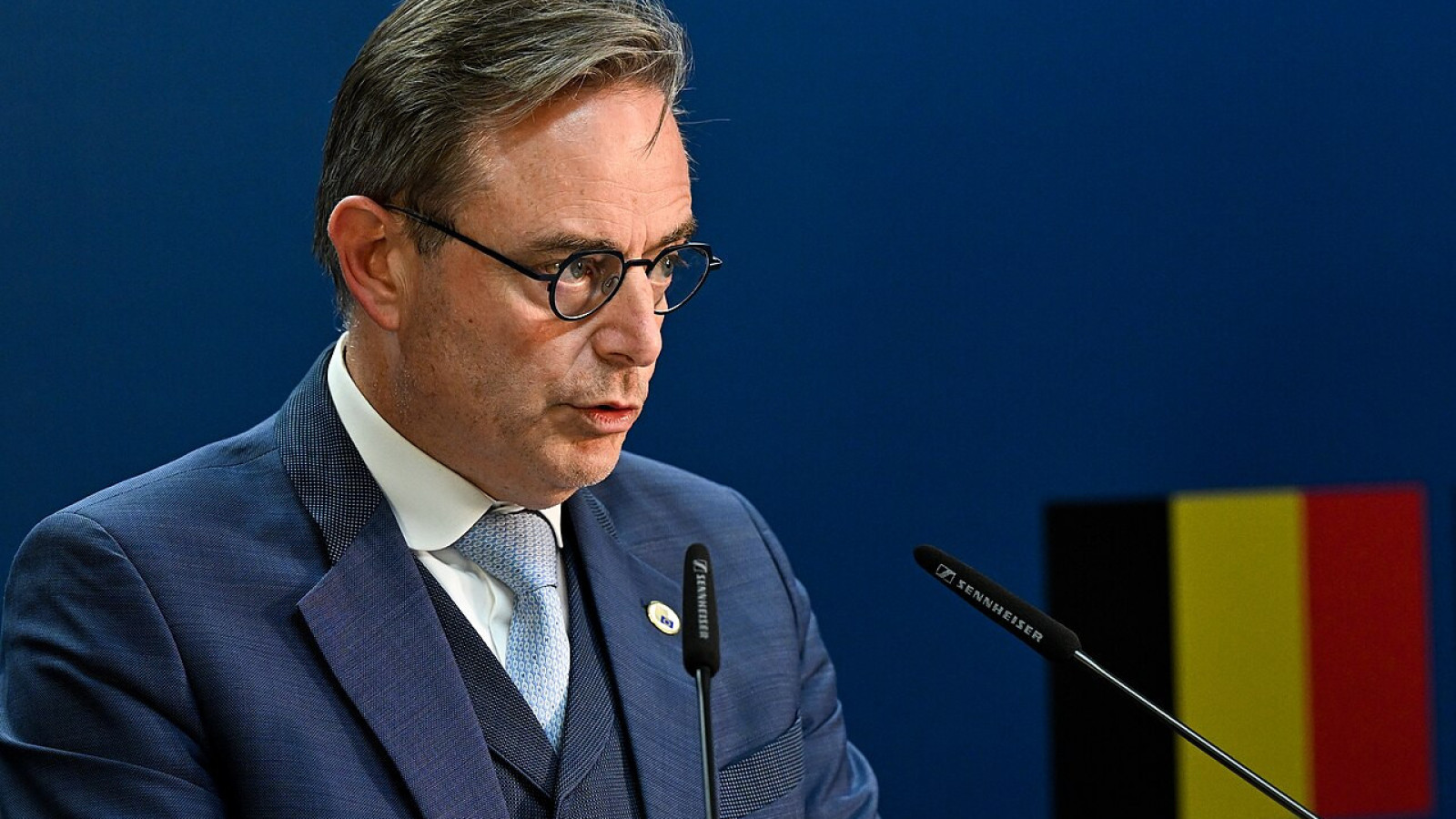
Bart De Wever (N-VA), now serving as Prime Minister of Belgium
Imagen de © European Union, 1998 – 2026, Licencia CC BY 2.0
.jpg)
In Belgium, there are three regions, each with its own parliament. The largest is Dutch-speaking Flanders. There is also French-speaking Wallonia and bilingual Brussels, although Dutch speakers constitute only a small minority there. In addition, there is a federal parliament comprising Dutch- and French-speaking members, where voters can only choose between candidates from their own electoral constituency. The far right is strongly represented only in Flanders.
In 1954, the Flemish nationalist Volksunie (VU) was founded and was quickly nicknamed “the party of the blacks” by the public, referring to Flemish collaborators with the Nazis. Over the years, it evolved into a pluralistic party. When the VU made concessions to French speakers in the late 1970s in order to gain greater autonomy for Flanders, a number of Flemish nationalists broke away from the VU and formed an electoral cartel under the name Vlaams Blok. This resulted in its first Member of Parliament. Initially primarily Flemish nationalist, Vlaams Blok rapidly evolved into a party with a strong anti-immigration program. On “Black Sunday,” November 24, 1991, the party significantly increased its number of elected representatives, winning 12 seats in the federal parliament.
In 2004, Vlaams Blok was convicted of racism by the court in Ghent, after which it changed its name to Vlaams Belang. In the 2004 elections, it obtained 24.2% of the vote in Flanders, winning 32 seats in the federal parliament. Vlaams Belang subsequently declined to 5.9% in Flanders in 2014, after which its resurgence began with the appointment in 2014 of the then 28-year-old Tom Van Grieken as the new party chairman. Previously, he was chairman of a far-right student association and studied advertising techniques. In the 2024 elections, Vlaams Belang became the second-largest party in Flanders, with 22.7% of the vote.
No coalition between the two most important far-right parties
The aforementioned Volksunie split in 2001 into a short-lived progressive party and a conservative party, the New Flemish Alliance (N-VA). In the 2003 elections, the N-VA secured only one seat in parliament. Meanwhile, the N-VA has become the largest party in Flanders, receiving 23.9% of the vote there in the 2024 elections. In the run-up to these elections, opinion polls consistently showed Vlaams Belang as the largest party. However, the election campaign ultimately turned in favor of the N-VA, whose party chairman, Bart De Wever, stated clearly for the first time that his party would not form a coalition with Vlaams Belang. A number of people within Vlaams Belang are too extreme for the N-VA. The way in which Vlaams Belang wants to achieve an independent Flanders is unrealistic; the N-VA prefers to govern Belgium with a right-wing program and thus push through the reforms it wants for Flanders.
In 2024, municipal elections were held somewhat later. These resulted in an absolute majority for Vlaams Belang in Ninove, a municipality of 41,000 inhabitants, and participation in the municipal administration of three other municipalities, with populations of 30,000, 29,000, and 20,000 respectively, in coalition with local parties.
Voorpost, Nationalist Student Association and Schild & Vrienden – other far-right organizations
Officially independent but, in practice, closely associated with Vlaams Belang, a number of far-right organizations are active in Flanders. These include Voorpost, which, alongside its own actions against Islam and refugees, among other things, supports other far-right initiatives, and the Nationalist Student Association (NSV). Both organizations are celebrating their 50th anniversary this year.
In 2017, Schild & Vrienden (S&V) was founded by Dries Van Langenhove. It is an identitarian organization similar to Génération Identitaire in France. Having originated in student circles, S&V currently amounts to very little. Its founder, Dries Van Langenhove, has meanwhile been convicted several times by the courts and is seeking an international career alongside the Austrian identitarian Martin Sellner and others.
Political allies in the European Parliament
In the latest election polls, Vlaams Belang and the N-VA (with Bart De Wever now serving as Prime Minister of Belgium) continue to alternate in the lead. Vlaams Belang has the strongest presence on various social media platforms. If, for example, a video surfaces of fighting immigrant youths, it is immediately widely disseminated by Vlaams Belang as proof of the failure of the multicultural society.
In the European Parliament, Vlaams Belang is part of the far-right Patriots for Europe (PfE) group, alongside the French Rassemblement National (RN) and the Hungarian Fidesz, among others. This does not prevent Vlaams Belang (VB) from regarding Alternative für Deutschland (AfD), which belongs to another European parliamentary group, as a political ally. The N-VA is a member of the ECR group, together with, among others, Fratelli d’Italia, the party of Italian Prime Minister Giorgia Meloni. Increasingly, we see the PfE and ECR cooperating with the Christian Democrats to support stricter rules for refugees, weaken the European Green Deal, and pursue other policies in this direction.
In Wallonia, far-right parties have failed to gain significant traction, partly because of a media cordon: the exclusion of these parties from the mainstream press. The latest attempt, Chez Nous, supported by Vlaams Belang and Rassemblement National, also proved to be a stillborn project. Subsequently, members of the Chez Nous leadership were absorbed into the classical liberal party MR, where chairman Georges-Louis Bouchez is attracting votes from the far right in French-speaking Belgium.
In Brussels, Vlaams Belang campaigns in both national languages. RN chairman Jordan Bardella has called on French-speaking voters in Brussels to vote for Vlaams Belang in order to advance its program on immigration, security, and related issues.
Ruud Martens publishes texts about the european far right on Affverzet. The website can also be followed in English by using the Google Translate button.
Redacción: Susanne Brust