Published
September 29th, 2026
Anti-Feminist Alliances: Networks, Infrastructure, and the AfD
Written by: Lina Dahm
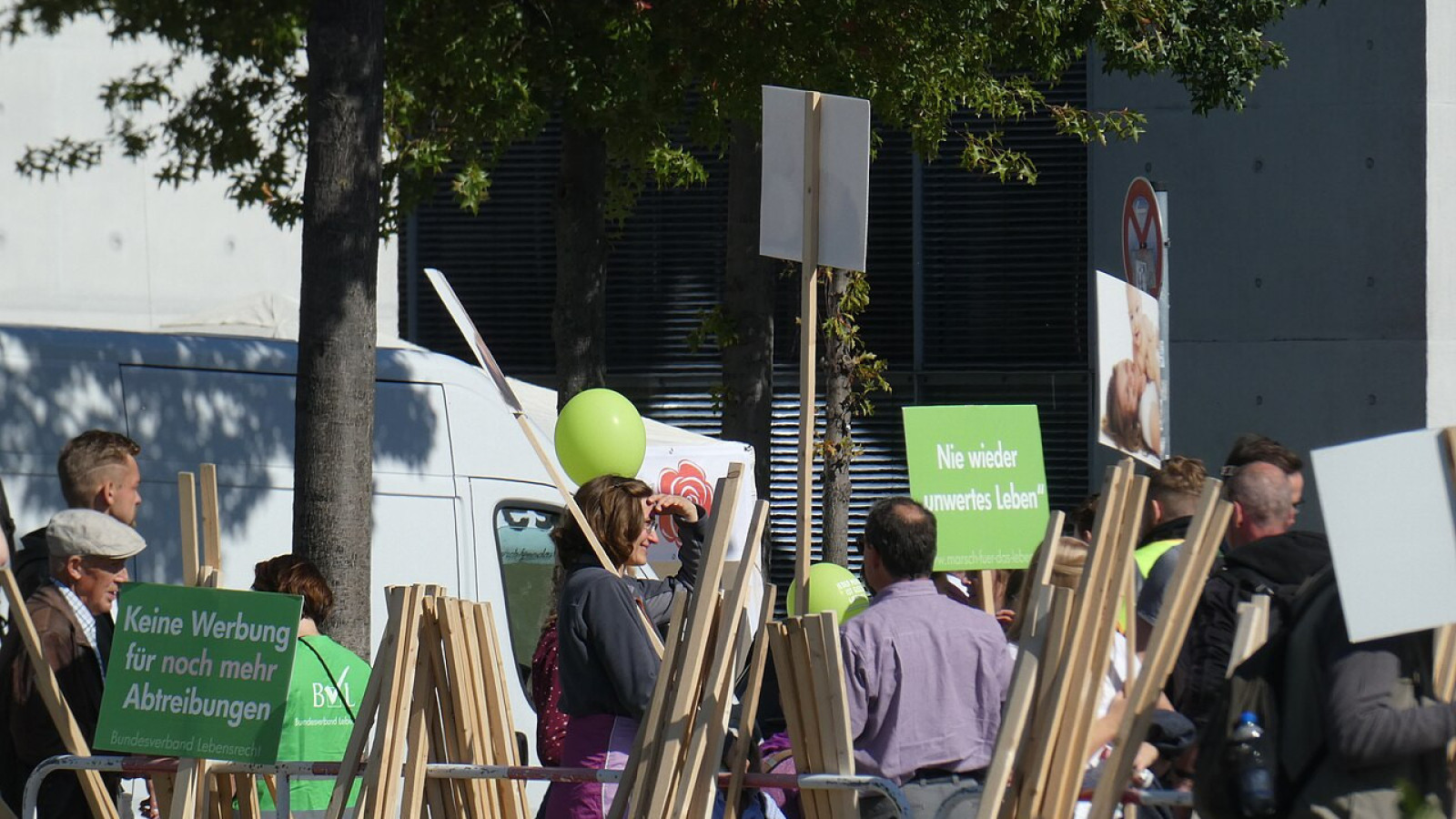
March for Life in Berlin, 2019
Image from C.Suthorn via wikimedia commons, License CC BY-SA 4.0

Here we document Lina Dahm’s presentation at the ReGA symposium on September 18, 2026. Lina Dahm is a freelance journalist and podcaster. For the podcast series Anti-Feminist Alliances, she has thoroughly researched anti-feminist networks. Her work focuses on anti-abortion activists, who often organize within a transnational anti-choice movement. In her presentation for the symposium, Lina Dahm used the Brosius-Gersdorf case to explain how anti-choice campaigns operate in Germany, which political camps they unite, and what international connections play a role.
“After careful consideration, I am no longer available for election as a judge of the Federal Constitutional Court.” That was Frauke Brosius-Gersdorf’s statement on August 7, 2025. Brosius-Gersdorf had been nominated by the SPD as a judge on the Federal Constitutional Court. The statement and her withdrawal from the candidacy were preceded by a massive campaign against her candidacy and her person. In the same statement, she wrote: “If politics continues to be driven by campaigns in the future, the process of electing judges to the Federal Constitutional Court risks being permanently damaged.”
I’m starting with this case because, to me, it highlights so much of what we need to discuss when we talk about the anti-choice movement and its connections. Not because the campaign against Brosius-Gersdorf marked the beginning of a new trend, but precisely because it did not. We’re talking about actors who have been practicing and testing exactly these kinds of campaigns for years: how to use petitions strategically, how to send form letters to lawmakers, how to organize demonstrations, how to use social media and social media marketing, how to engage in lobbying and media relations, and, increasingly, how to wage legal battles to achieve their own goals.
These actors are connected to one another in specific ways. Today, I’d like to focus less on what anti-feminism is and instead use 16 points to show what the debate on abortion in particular—and anti-feminism in general—makes possible politically: Who are the actors? What infrastructure have they built up? How do their alliances operate? What role does the AfD play in this? And above all: What does this mean for those who lead emancipatory NGOs or projects that could come under the scrutiny of these actors due to their positions or work, and for the work of political parties, journalists, experts, etc.?
1. Brosius-Gersdorf: What actually happens during a campaign like this?
Let’s take another look at the campaign against Brosius-Gersdorf. A central target of the campaign was her statements on the topic of abortion. Brosius-Gersdorf had served as an expert on a commission established by the federal government to reform abortion laws—specifically, §218 of the Criminal Code. One statement from this context was repeatedly highlighted, particularly by organized anti-abortion activists: “There are good reasons why the guarantee of human dignity applies only from the moment of birth.” The context of this statement played hardly any role in the campaign; contrary to what many claimed, she was not, for example, arguing for a general allowance of abortions up until birth.
The key point was this: Here is a constitutional law expert who wants to liberalize abortion laws. And that provided a point of attack that works extremely well, especially for the anti-choice movement. Abortion is an issue that makes it very easy to mobilize people. Annika Brockschmidt recently described the issue as a “marketing strategy,” and that sums it up very well: It’s about life and death. About children. About women. About morality. About religion. About the question of when human life begins. And it’s an issue on which many people have an opinion, at least intuitively. That’s what makes it so politically useful. But then something interesting happened during the campaign. A debate over abortion rights turned into a debate about a person. And that debate about a person turned into a debate about justice. And that debate about justice turned into a debate about who is even legitimate to decide on our constitution. And this is where various political interests converge.
The anti-choice movement has an interest in preventing a supporter of liberalizing abortion laws from serving as a judge. Although she would not even have sat on the chamber that would have decided on a possible reform of §218 of the German Criminal Code (StGB)—she would, however, have ruled on a potential ban on the AfD—and so it was only logical that (far-right) media outlets and the AfD had an interest in preventing a supposedly “left-wing” or “activist” constitutional judge from taking office.
That doesn’t mean there was a central body steering this entire campaign. And that’s exactly what I think is important. We should move away from the idea that an alliance only exists when all participants sit down together at a table and develop a campaign plan. Because these political alliances work differently. Actors can have different interests and still pursue the same goal—especially when it comes to anti-feminism, they adopt content developed by others, provide reach or access to politicians, or bring so-called experts into political processes. And that is exactly what we saw in the campaign against Frauke Brosius-Gersdorf.
2. It’s not just ideology that matters—it’s the infrastructure
When we talk about the anti-choice movement, many people first think of demonstrations: the March for Life; vigils outside clinics; activists praying. Of course, these things exist. But if we want to understand how this movement functions politically, this perspective isn’t enough. That’s because a large part of the work takes place where we see it least: in offices; in lobbying meetings; in legal proceedings. In parliaments and parliamentary committees. In behind-the-scenes discussions. In social media departments. In the production of studies, position papers, and briefings. And this is precisely where the movement has become much more professional in recent years.
The German “pro-life” movement is not a mass movement. We’re talking about approximately 50 organizations, some of which are larger or more influential than others—though generally not very so. But it is comparatively well-connected and sets the agenda and talking points. That, to me, is the crucial point: You don’t have to be particularly large if you’re particularly well-organized.
3. An example: 1000plus and Kristijan Aufiero
Take 1000plus-Profemina, for example. It used to be an association; today it is a nonprofit limited company (GmbH) and, according to its managing director, Kristijan Aufiero, the largest pro-life organization in Europe. 1000plus describes itself as a counseling and support organization for women facing pregnancy-related conflicts. At the same time, the organization engages in political advocacy and operates its own news platform called Corrigenda. The company’s lobbying registry explicitly states that it contacts politicians at various levels through letters, emails, and petitions, with the goal of preventing further liberalization of abortion laws.
What’s interesting is that in February 2025, Kristijan Aufiero was heard in the Bundestag as an expert witness appointed by the AfD on the reform of abortion laws. He thus functions as an expert there, contributing his supposed expertise to the parliamentary debate. And his position was quite clear: He argued against legalizing abortion in early pregnancy and in favor of “life-affirming” counseling. In 2026, he was again invited as an expert at the AfD’s suggestion, this time to the Health Committee. This is a development we should keep an eye on.
After all, the AfD, which takes a clear stand against abortion, has an infrastructure it can draw upon here. Within the “pro-life” movement, it has organizations and individuals who have been working in this field for decades and are happy to collaborate with the party. There, it also finds—when necessary—legal expertise and campaign experience in this area. In this way, the AfD becomes the parliamentary arm of organized anti-abortion activists.
4. Another example: 40 Days for Life and Tomislav Čunović
A similar example is the lawyer Tomislav Čunović, who serves as Executive Director of International Affairs at 40 Days for Life and as Counsel for the Institute of Law & Justice, the legal arm of 40 Days. 40 Days for Life is best known for its 40-day vigils outside facilities that provide abortions or counseling. But also for this organization—which originated in the U.S.—it is not just about street activism.
In 2024, Čunović was also invited by the AfD to serve as an expert witness at a Bundestag hearing on protecting pregnant women from so-called “sidewalk harassment.” His position was that a legally mandated safety distance of 100 meters constituted a disproportionate infringement on the freedom of assembly. It is one of many examples of how their own anti-feminist practices—the constant siege of counseling centers and clinics, which has been proven to harass people—are framed as a fundamental right, in this case as freedom of assembly:
“We want to demonstrate in front of clinics” turns into: “We are defending freedom of assembly.” We want to prevent abortions” turns into: “We are defending the right to life.”
“We want to restrict sex education” turns into: “We are defending parental rights.”
“We reject trans people” turns into: “We are protecting children.”
5. This is precisely where the function of anti-feminist issues lies
For me, this is an important political function of anti-feminism—not just anti-feminism, but that’s the main focus today—and it is precisely this function that can bring very different political projects together. Not because everyone involved wants the same thing, but because certain issues serve as common points of conflict. Abortion is one. “Gender” is one. Trans rights are one. Sex education is one. Family politics is one. And the concept of child protection is particularly powerful.
We’ve seen this, for example, in protests against drag readings. In Munich in 2023, very different groups stood side by side at such protests: pandemic deniers, the AfD, student fraternities, Identitarians, Christian fundamentalists, organized anti-abortion activists, and trans-exclusionary women’s rights activists. What united them was not a shared political agenda. It was a shared enemy and a shared narrative: We must protect children. This is incredibly appealing politically. After all, who would want to say, “I’m against protecting children”? No one. Radical political demands don’t have to be phrased radically. They can be translated into language that resonates deeply with society at large.
6. The AfD as an amplifying force—and not just as another player
Let’s return to the topic of the AfD. I wouldn’t simply list the AfD among anti-feminist actors—though they undoubtedly are. But due to their growing influence, their role has now changed. They function as a political amplifier and an institutional interface. It is the aforementioned parliamentary arm of anti-feminists. It can bring issues—which were previously discussed mainly in activist or religiously conservative circles—into parliamentary debates. It invites figures from these circles as experts and incorporates their positions into parliamentary inquiries. When reading their platforms, one finds the narratives and demands of organized anti-abortion activists. The AfD attends protests—and organizes them herself. Today, for example, an AfD pre-event on the topic of “Protecting Life in Woke Times” is taking place at Cologne City Hall—explicitly labeled as a supporting event for tomorrow’s March for Life. The AfD amplifies campaigns and can simultaneously link these issues to other political projects.
If you take a look at the AfD’s 2025 federal election platform, this is quite clear. It states that the current provisions of §218 et seq. are “balanced” and do not require any changes. At the same time, the AfD calls, among other things, for ultrasound images to be shown during pregnancy conflict counseling, rejects the recognition of abortion as a human right, and wants to deny funding to organizations that “promote or trivialize” abortions. The issue of abortion is therefore by no means merely a marginal issue. It is part of a broader sociopolitical agenda.
7. Abortion is only one aspect of this
But it is not enough to look only at the AfD’s positions on abortion. In the same chapter of the AfD’s platform, we find a call for policies that prioritize the traditional family. We find the notion that there are two biological sexes. We find attacks on the Self-Determination Act. We find the claim that children and adolescents are being manipulated by a “trans cult.” And we find a strong link between family, gender, and population policies.
The question is no longer just what the AfD thinks about abortion, but what kind of society the AfD is striving for and what role reproduction, sexual self-determination, and gender self-determination play in that. The AfD talks about demographics, linking this to birth rates, family, gender, and migration—and in doing so, reveals just how profoundly it seeks to influence individuals and their life plans in order to achieve what it considers a desirable society.
Personally, I believe that the issue of demographics will play a greater role in public debates in the coming years. As early as 2022, Swantje Höft, Judith Goetz, Livia Sz. Oláh, and Andrea Pető wrote in an article in the Austrian newspaper Der Standard: “The narrative of demographic change has opened up opportunities for the far right to modernize racist discourses and establish their issues in mainstream media, thereby reaching the so-called ‘center of society.’” Here, too, they emphasize the potential to connect with broad segments of society where the topic is repeatedly discussed, and they go on to argue: “Feminist and progressive engagement with the issue is therefore just as urgently needed as the development of counter-narratives rooted in solidarity, in order to ensure that the field is not left to the right.”
8. Reproduction and the Far Right
For when the far right talks about demographics, it’s not just about the abstract number of births but often about who should have children in the future and who shouldn’t. On the one hand, there is migration as an alleged threat to national identity. On the other hand, there is the demand for more births within “our own” population.
This makes family and reproductive policy part of a larger social project. And that is why the demand for “remigration”—that is, the expulsion and deportation of people who, in their view, do not belong here—and anti-feminist policies go hand in hand. Underlying all of this is an ethno-nationalist and racist conception of nation, family, gender, and population.
9. But the AfD isn't building this infrastructure on its own
And now I’d like to return to the topic of international networks. After all, this development is not a German AfD phenomenon, but a transnational one. There are a multitude of organizations involved here—as Neil Datta of the EPF has highlighted in his reports on Agenda Europe, as well as in the two—I’ll call them financial analyses—“Tip of the Iceberg” and “The Next Wave: How Religious Extremism Is Regaining Power.”
Today, I’ll single out one of the organizations listed there as an example: Alliance Defending Freedom International (ADF). The ADF is a lobbying organization that has significantly increased its investments in Europe in recent years, as research by the EPF shows. The ADF is not the only U.S. organization investing in Europe and Germany to mobilize locally against reproductive or queer rights. There are also Tradition, Family, Private Property (TFP) and Heartbeat International—which is currently holding a conference here in Berlin—as well as the World Youth Alliance, to name just a few.
But to me, ADF International is emblematic of this transnational network that German anti-feminists have been helping to fund for several years—and, above all, equipping with knowledge and experience. ADF provides concrete support in legal cases—for example, in enforcing the right of organized anti-abortion activists to hold vigils and rallies within the 100-meter “no-go zone” established two years ago. With success.
Funds also go toward organizing conferences, preparing briefings, and arranging background briefings at the European Parliament, where they lobby conservative and far-right political groups and parties. The ADF has brought the culture war into the courtrooms of this republic and deliberately intervenes in debates on freedom of expression, assembly, and religion in order to frame right-wing and conservative positions as legitimate “freedom issues.” Civil liberties are strategically exploited—essentially as “weaponized free speech”—to fend off criticism and shift the boundaries of what is socially acceptable to the right.
Is ADF simply a far-right organization? No, that would be an oversimplification. But it does make its expertise and infrastructure available to the far right and, on a case-by-case basis, also collaborates with it or actively lobbies on its behalf. One example is an event on the Digital Services Act held in May 2025, where the ADF, together with members of the Patriots for Europe and ECR parliamentary groups, discussed about “The Digital Services Act and Threats to Freedom of Expression.” They also lobby on issues such as abortion, surrogacy, persecution of Christians, freedom of expression, etc.
10. This bridge is transnational
We are seeing a pattern in which these issues and the political strategies associated with them are spreading across borders. The overturning of Roe v. Wade was celebrated by the German “pro-life” movement. Strategies used there are sometimes copied and adopted here in an adapted form. U.S. activists appear at German events or send video messages. Matt Britton of 40 Days for Life spoke at the March for Life in Munich; Lila Rose of Live Action sent a video message; and Bishop Robert Barron also explicitly addressed the culture war against liberal abortion laws as an international conflict in a video message.
The U.S. serves as a model. German anti-choice activists are closely monitoring what is happening in the U.S., and we should therefore keep a close eye on developments there—and, of course, in other authoritarian states. After all, there are organizations and associations here in Germany that have these strategies at their disposal and can implement them. I would like to remind you of the campaign against Frauke Brosius-Gersdorf.
11. The really interesting part: The AfD doesn't need to completely control the alliance
I don't think we should view current developments as part of some grand, centrally controlled plan. It’s much more interesting to think of the whole thing as a network model. We have various nodes. There are anti-choice organizations. There are Christian fundamentalist groups. There are right-wing media outlets. There’s the AfD and other far-right parties. There are international lobbying organizations. There are legal actors. There are influencers. And there are individuals who move between these circles.
Not all of them share the same ideology. But they can use the same resources, the same language, and the same narratives. And they can reinforce one another. One has the expertise. Another one has the money. The next one has reach. Someone else has access to a parliament. And yet another person can organize a demonstration. Together, this results in political influence.
12. What has changed?
I would therefore argue that we are dealing with three developments:
First: professionalization. The anti-choice movement is no longer just a protest movement. It increasingly relies on lobbying, legal strategies, media outreach, and political expertise.
Second: trans-nationalization. Organizations, arguments, campaign strategies, and personnel move across borders. What works in the U.S. can be adapted in Europe. What works in one European country can reappear in another.
Third: institutionalization. And this is perhaps the most important point. Actors from these circles are increasingly gaining access to political institutions. They are heard and invited as experts, quoted, and their arguments are incorporated into parliamentary debates. Incidentally, this has been—and remains—one of the central goals of Agenda Europe: to elevate its own people to this expert status. And in that regard, they have indeed been successful. If we look at Germany, in addition to the AfD and with regard to “pro-life” issues such as abortion, surrogacy, and assisted suicide, the CDU/CSU is also significant. This is because they can offer an institutional infrastructure that a small extra-parliamentary milieu could never have on its own.
13. What does this mean for us?
I believe we need to prepare ourselves for more campaigns like this. But not necessarily campaigns that look exactly like the one against Brosius-Gersdorf. That would be short-sighted. The next campaign could target a counseling center. A female doctor. An organization. A sex educator. A journalist. A trans person. A scientist. A book. Or a supposedly “left-wing” institution. The target may change. The infrastructure remains. That’s why we should not only learn to respond to individual campaigns but also look at what’s happening within the infrastructure I just described.
14. “Follow the infrastructure”
More specifically, this could mean: When a narrative suddenly emerges, we should ask: where does it come from? Who first came up with it? Is it really new? Or was it already used two years ago in the U.S., in Brussels, or in another European country? Who is spreading it? Which organizations are picking it up? Which media outlets are helping to amplify it? Which politicians are adopting it? Who is presented as an expert? And—even if this is often difficult in this country—who is funding the infrastructure behind it?
To me, this is a much more productive form of analysis than simply saying, “That’s anti-feminist.” We often already know that. The more interesting question is: How does an anti-feminist position translate into political influence or even power?
15. We must take our own alliances seriously
Just as anti-feminist politics successfully builds bridges between different communities, so do feminist theory and practice. We, too, have networks, and they have achieved a great deal—especially in the realm of feminist politics—over the past ten to fifteen years. And these are networks that complement each other well: activists, lawyers, medical professionals, scholars, journalists, and networkers.
16. My call to action
After all, anti-feminist politics is not a series of separate, isolated struggles. The campaign against Brosius-Gersdorf was not merely a campaign against a female lawyer. It was an example of how existing political infrastructures can function.
The hearings of Kristijan Aufiero and Tomislav Čunović show how extra-parliamentary actors can gain access to institutional spaces through the AfD.
ADF demonstrates how legal and political strategies can be organized on an international scale.
And the German “pro-life” movement shows that it is possible to build up an infrastructure over the course of years that can then be mobilized very quickly at the right moment.
We should take this seriously. Not because we should now interpret every petition that appears on Citizen Go and every conservative statement as part of a grand conspiracy. But precisely because we need to take a closer look. Who is working with whom? Who is granting access to whom? What strategies are being developed internationally? Which of these are currently being tested in Germany?
And: what infrastructure do we need so that we don’t wait to react until the next campaign is already underway? Anti-feminist networks have been building these bridges for years. Our task, therefore, should not be merely to tear down individual bridges. We should build our own. And we should do so now—before we need them.
Redaction & Translation: Susanne Brust