Published
September 9th, 2026
Berlin Campaign Conference 2026: The german center-right's identity crisis
Written by: Andrea Dip
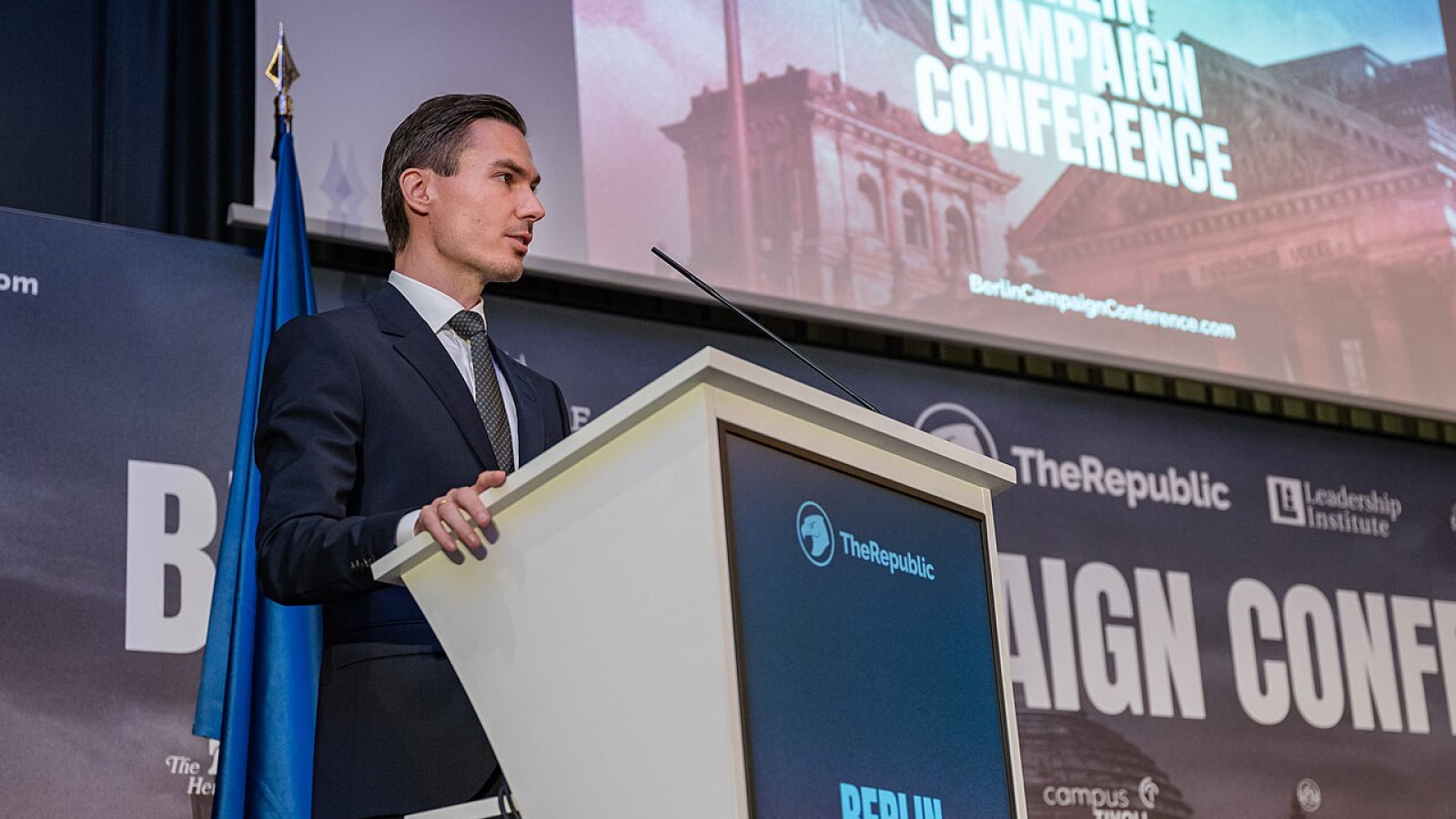
Armin Petschner-Multari, founder of TheRepublic, at the Berlin Campaign Conference 2025
Image from Politiketcetera via wikimedia commons, License CC BY 4.0

In a luxurious room with just over 100 seats in a Berlin hotel, a group of campaign professionals, communicators, senior political and party officials, think tank representatives, and opinion leaders gathered between September 3 and 4 for the third edition of the Berlin Campaign Conference (BCC). The event has been organized since 2024 by the conservative think tank TheRepublic. Founded in 2021 in Hanover by Armin Petschner-Multari—a former social media strategist for the CSU—TheRepublic's early campaigns included themes such as "Against Gender Madness" and declared on its website that it wanted to counter the political drift to the left. In 2026, the conference's aim was to promote Berlin as the epicenter of the center-right.
Supporting the event were the Union Stiftung, a traditional organization aligned with the CDU, headquartered in Saarbrücken; the International Democracy Union (IDU), which calls itself "the global alliance of the center-right," founded in the 1980s by figures such as Margaret Thatcher and George H.W. Bush; and the Leadership Institute—an American conservative organization created in 1979 that has "trained" more than 200,000 politicians, including former Vice President Mike Pence. The Leadership Institute is also one of the supporters of Project 2025, considered a manual for Donald Trump's current presidency. In 2024, when the first edition of the BCC took place, the American organization The Heritage Foundation—author of Project 2025—was also listed among the supporters.
This year's audience did not fill the room. Perhaps due to the ticket price: €850.00, or because there was control over who could attend—attendees needed to receive a code to complete registration. People who had attended previous events received an invitation for 2026. Partner journalists attempted to get credentials but received no response from the organizers.
Men predominated, both among speakers and in the audience, with a notable presence of young people. This year, most of the talks were about how to build successful political campaigns, how to mobilize social media and deal with AI, what to do with the crisis plaguing right-wing and center-right parties, censorship (basically complaining about European data protection laws), and addressed current issues in Germany, such as the rise of the AfD, the elections in Saxony-Anhalt, the present and future of the CDU, and how the center-right should drop the pragmatic tone and even appear "less polished" to capture voters' sentiments at a time when, according to political strategist Luke Martz, director of Riverfront Strategy, "data doesn't move the numbers, narratives do." Other catchy phrases used during the two days were "make CDU cool," "make stability sexy again," and "friction is fuel." The main guest, who opened the conference with his input, was former Federal Minister for Economic Affairs and Energy of the CDU Peter Altmaier.
Among the participants were also Fabian Beine, head of digital strategy for the CDU; Antonia Ferrier, a longtime Republican strategist; Kevin Gentry, a former senior executive at Koch Brothers—a company that made billions from oil, fuels, and pipelines; Agnieszka Gryz, political strategist currently serving as an advisor to the Deputy Prime Minister of Poland; Stewart Harper, vice president of the National Conservative Convention and Member of the Party Board of the Conservative Party of the United Kingdom; and Or Yissachar-Veres, an Israeli national security expert, founder and former Executive Director of the David Institute for Security Policy, and former Head of Research at the Israel Defense and Security Forum.
Day one
The first day's program focused on the CDU crisis and the rise of the AfD. Fabian Beine, a CDU politician who led the "TEAM MERZ 2025" campaign for the 2025 federal elections, analyzed the mistakes and successes of the campaign. Clara von Nathusius, a political influencer and treasurer of the Young Union, provocatively stated that "populism is not a sin, it's a format" and that "conviction is the new currency in politics."
But the most highlighted speech was Peter Altmaier's. In his address, he defended a long-term vision for the center-right, emphasizing the need for global alliances beyond the US and Europe. He said he was proud of the party's history and figures like Konrad Adenauer, Helmut Kohl, and Angela Merkel and criticized the "America First" (MAGA) concept, arguing that unilateral tariffs would isolate the United States. He argued that allies need to see benefits in cooperation, not just unilateral impositions. Regarding China, he took a pragmatic tone: instead of containment, he proposed integration with the West, even citing the Bayern Munich fan club in China as an example of cultural connections. During a panel following his input, he took another jab at Trumpism, saying that far-right populism is a global phenomenon—from the Tea Party and MAGA in the US, Le Pen in France, Reform in the UK, PiS in Poland. For him, right-wing positions are legitimate, but extremism should never be tolerated within a party. On the topic of immigration, unlike other guests who spoke about closing borders and how immigration harms countries, Altmaier argued that it is necessary not only to demand from immigrants but also to offer perspectives, and mentioned immigrants who arrived in the 1990s and their descendants as part of German society. "I am a great defender of German-American friendship. We owe a great deal to the US. But I am not convinced that the MAGA concept will work in the world we live in today. When you say 'America First', and when you say 'I'm going to tax and raise tariffs to benefit my country' and you don't take into account the justified interests of others, why should others be your allies and cooperate with you? In the end, I fear that this great country with presidents like Ronald Reagan will end up in a more isolated situation than it has ever been since the end of World War II," he stated.
In the panel "Germany in an Age of Upheaval: A Litmus Test for Christian Democrats" with Fabian Beine, Clara von Nathusius,, Peter Altmaier, and Michael Scholl, managing director of Union Stiftung, there was a debate over whether the rise of the AfD is a problem of eastern Germany or the entire country. Most speakers agreed that it was a problem of regions with fragile economies and that the party's supporters are generally teachers, the unemployed, people afraid of losing jobs and property. Altmaier, however, argued that this is a global problem, citing "Tea Party and MAGA in the US, Le Pen in France, Reform in the UK, PiS in Poland." On the challenges facing the CDU, the panel discussed overpromising in campaigns and underdelivering in government, lack of long-term vision for Germany, absence of "faces" that people want to vote for, and it was said that the CDU has become the party that is "against something" (AfD, Die Linke) but offers nothing positive. Clara von Nathusius said that the CDU has never been a movement—it is stable, firm. She argued that today people follow people and movements, giving the example of MAGA: "people didn't vote for Republicans, they voted for Trump." She said the CDU needs to create a movement and "make stability sexy again." On what to do about the AfD's victory in Saxony-Anhalt, the speakers were more vague. But most agreed that a coalition with Die Linke and the Greens would not be a viable option.
Another recurring theme throughout the event was hostility toward the press. Most speakers saw the media as an obstacle to be overcome. "The press is a pain in the ass," said one of the speakers.
An interesting presentation was that of Attila Kovács, Chief Executive Officer of Eulytix. In "The Changing Architecture of the European Right: A Data-Driven Approach," he presented data from his Budapest-based big data company on the fragmentation of the European right in the European Parliament from 2014 to 2026. His analysis showed that the right is polarized between the European People's Party (center-right) and more radical groups (Patriots, ECR). Migration and Israel are themes that unite the right, while environmental issues and Hungary divide it. Kovács highlighted that radical parties like Fidesz have limited legislative impact—they "may be loud, but they don't have the pen." He said that the internal cohesion of left-wing parties (Greens, S&D, ALDE) is greater, by definition, than that of right-wing parties, and that Fidesz has been locked in its bubble because no one wanted to cooperate with them on proposing legislative amendments. Almost 83% of Fidesz's amendments were co-sponsored only by Fidesz MEPs.
Day two
The second day's program brought more North American speakers. Ron Nehring (Leadership Institute), Antonia Ferrier (En Avant Strategies), and Dr. Julia Reuss, Public Policy Director of Central Europe at Meta, were among the speakers. Cases of successful campaigns by Republican Party politicians were presented as models.
The most ideological speech of the entire conference was that of Or Yissachar-Veres, Vice-President of Research and Content at the Israel Defense and Security Forum (IDSF), who closed the second day. He argued that the Western left is using anti-Israel rhetoric and appealing to minorities as a way to win over voters, which he classified as senseless and antisemitic, and a matter for Israel, not the rest of the world. "Why are we talking about free Palestine if you're in Michigan?" he asked ironically. He also spent a long time criticizing New York Mayor Zohran Mamdani, who according to him had used the Palestinian cause opportunistically. He spoke about a phenomenon he calls the Red Green Alliance. "Basically, progressives and Islamists are unifying their struggle into a coalition to take on the centers of power." On the screen, he ended his speech with the image of a KfC restaurant, with a chicken on the roof holding a sign that said "queers for Palestine," which drew laughter and photos from the audience. After his speech, one of the American guests asked whether the solution would be to recognize that immigration from the Third World has harmed the United States, and when Or Yissachar-Veres replied that there are differences between types of immigrants, the guest responded: "I'm not worried about the Canadians coming to Michigan. I'm worried about the ones arriving by plane," and criticized what he called non-meritocratic migration. Another American female speaker referred to "queers for Palestine, all this sort of banana stuff."
While the 2024 edition of the BCC was largely focused on the United States and Trumpism, BCC 2026 revealed a German center-right in search of identity, trying at all costs to distance itself from far-right populism while clearly embracing some of its agendas. Between the pragmatic stability that no longer seduces voters and the emotional populism that conquers on social media, the organizers are betting on (once again) importing American methods into German territory. Whether Berlin will in fact become the "hub of center-right thought"—or just an outpost of Trumpist tactics in Europe—remains an open bet.
A shorter version of this report was published in german language in taz.
Redaction: Susanne Brust