Veröffentlichung
5. October 2026
On the big stage—and behind the scenes
Verfasst von: Eike Sanders
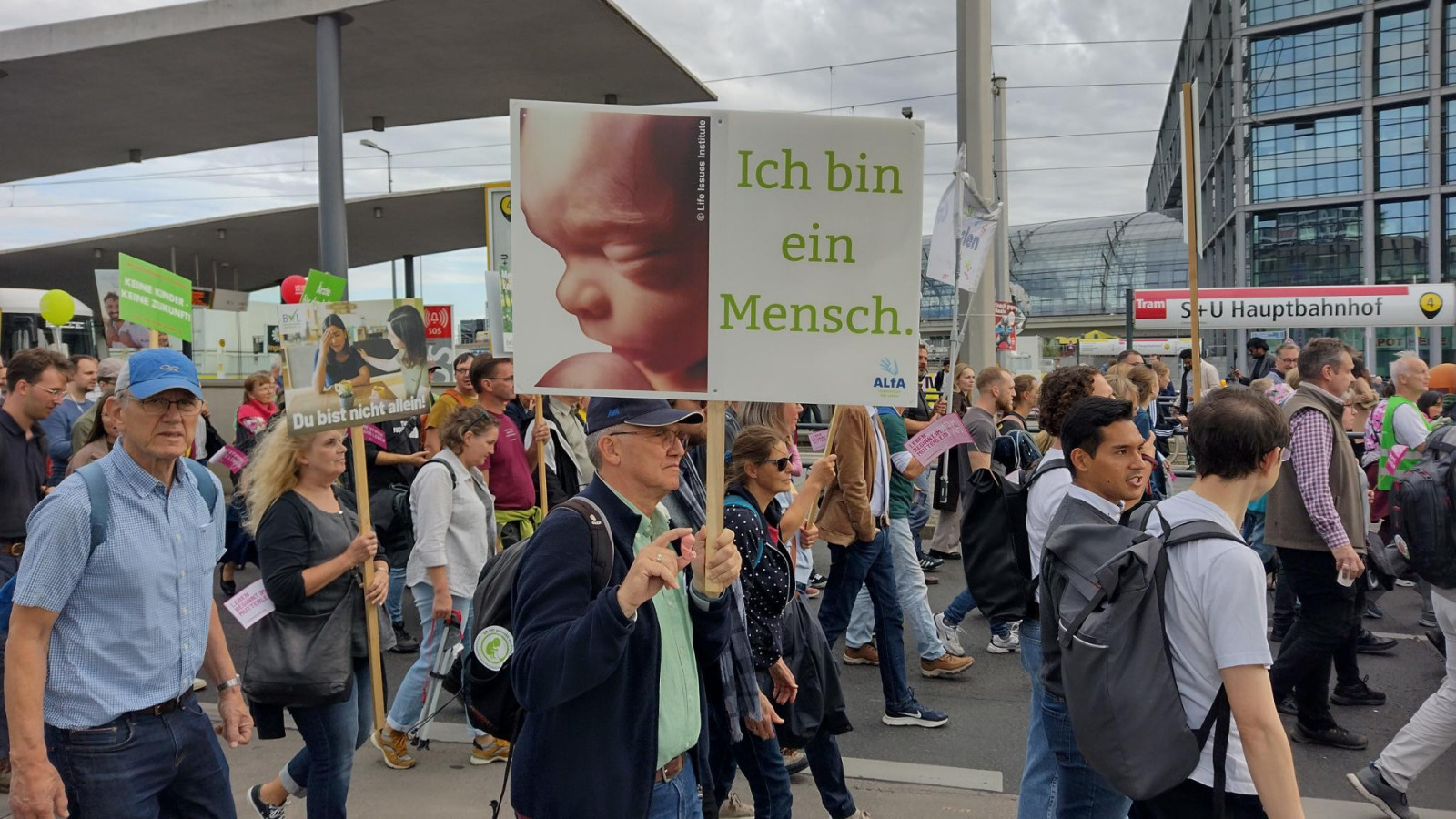
Participants in the March for Life 2026 are passing the Berlin Central Station, holding posters like 'I am a human' or 'You are not alone'. One person in the front is holding a plastic replication of a human fetus between his fingers.
Bild von ReGA, Lizenz Rega
How Anti-Abortion Activists Are Exploiting the Issue of Surrogacy
On September 19, anti-abortion activists once again held the so-called “March for Life” in Berlin and Cologne—and this time, they focused on surrogacy. Even though their presence on the streets continues to seem bizarre, there is a dangerously active movement taking place far from the stage.
“When we talk about surrogacy, we read a lot in the headlines about the joy of having a baby. The joy of having a baby in the Streeck household, the joy of having a baby in the Spahn household. […] That’s not the joy of having a baby—it’s a nightmare,” Cornelia Kaminski shouted from the main stage at Berlin Central Station. Kaminski is the national chairwoman of Campaign Right to Life for All (ALfA—Aktion Lebensrecht für Alle), likely the “pro-life” organization with the largest membership in Germany, and her audience responded with cries of outrage and applause for her powerful words.
The scandal surrounding CDU politician Jens Spahn had stirred up emotions across the country that summer: As was revealed in July, Spahn—contrary to his party’s position and also contrary to his own previous statements on the subject—had started a family with his husband through a surrogacy arrangement. He has since resigned from his position as parliamentary group leader of the conservative Christian-Democrats, with his blatant double standard proving to be his undoing.
Within the CDU/CSU, the topic of surrogacy has once again faded from the spotlight; however, within the “pro-life” movement, it has been a hot-button issue since July, dominating the newsletters, magazines, and blogs of the Federal Association for the Right to Life (BVL—Bundesverband Lebensrecht), its 16 member organizations—all of which are anti-abortion groups—and many activists in the movement. The BVL, which organizes the Marches for Life, stated as early as July in a press release: “The Federal Association for the Right to Life calls for clear legislation modeled after Italy’s, which completely prohibits this form of child trafficking and the exploitation of women and does not allow any loopholes for the import of purchased children.” In Italy, since October 2024, the use of surrogacy abroad has also been a criminal offense, and recognition of parenthood afterward is virtually impossible. What conservatives who advocate for the Italian model in Germany generally fail to mention is that loopholes do indeed exist—but not for gay couples. Even with a foreign birth certificate in which they are already listed as parents, it remains obvious in the case of two cis men that neither of them could have given birth to the child. Cisgender heterosexual couples, on the other hand, can conceal the way they started their family much more easily.
On stage in Berlin, Cornelia Kaminski took it a step further: “It’s not enough that we have a ban on surrogacy in Germany if people with a lot of money then come along and say, ‘I’ll get around that.’ […] We have a very special responsibility here in Germany. We know all too well what it means when human dignity is trampled underfoot, when we say, ‘You deserve respect, but you don’t.’ […] That is why we demand: Germany must take the lead in a movement to ban surrogacy internationally. We need an international ban on this crime!” Following this implicit moral reference to “Never Again”—which draws on the crimes of Nazi euthanasia and the Shoah—anti-abortion activist Kaminski shifted the focus of her speech to the unborn or newborn child. Unlike its mother, she argued, the child had not signed a contract and had not been asked whether it agreed to “never see its mother again” and to not know “its parents, its real biological parents,” and “its origins.” Therefore, the principle must be: “The child comes first.”
The smear campaign has already been rehearsed
In a veiled reference to “a failed judge on the Federal Constitutional Court,” Kaminiski, in her speech on surrogacy, drew a connection to the smear campaign against Frauke Brosius-Gersdorf, who had been nominated as a judge for the Federal Constitutional Court. In the summer of the previous year, an alliance of Christian fundamentalist actors professionally orchestrated the spread of lies and slander about Brosius-Gersdorf in order to pressure members of the Bundestag to withdraw their support for her candidacy. Ultimately, Brosius-Gersdorf withdrew her candidacy herself. The “pro-life” movement played a key role in this profoundly undemocratic process. The BVL concluded that, given Brosius-Gersdorf’s position on surrogacy, they were “all the more grateful” that another candidate was elected to the position.
What appears so passive here, however, should be interpreted as a signal to their own target audience: Look, our work is successful! The movement will want to replicate this success on other issues as well: ALfA had already organized an event in March titled “Children and Commerce—The Business of Surrogacy and the Desire for Children.” It gave the appearance of a medical conference, but here, too, massive amounts of misinformation, anti-feminist resentment, and transphobic and homophobic incitement were spread—even including wild conspiracy theories about the trade in babies as organ donors. For years, the movement has been attempting to address other areas of medical ethics—in addition to its main focus on abortion—that tend to be neglected in public discourse. In addition to surrogacy, these include reproductive technologies, “transhumanism,” and euthanasia or assisted suicide, where the movement’s activists position themselves as the only audible voice in civil society and thereby attempt to influence public opinion.
Churches are distancing themselves—the right is closing ranks
However, on September 19, the successes and efforts of the anti-abortion movement did not translate into mass mobilization in either Cologne or Berlin. The BVL’s Marches for Life drew roughly the same number of participants as the previous year: about 2,000 in Berlin and 1,700 in Cologne (see our report from last year). As a result, the numbers fell significantly short of the organizers’ projections and the peak of mobilization in 2016, which saw about 5,000 participants. This should come as no surprise to anyone—not even within the movement itself.
With each passing year, the established churches are distancing themselves further from the event and its leading figures. While, from the very beginning, only congregations outside the Protestant Church in Germany (EKD)—that is, evangelical and free church groups—supported the movement, the mobilization potential within the Catholic Church is much more firmly established. Yet it is dwindling: Over the years, churches in Germany have repeatedly been withheld from the movement for its closing services, and messages of greeting and participation by church officials have declined. In 2023, the Catholic youth association BDKJ of the Archdiocese of Cologne officially called on the faithful not to participate in the “March for Life,” arguing that it employs recurring misogynistic rhetoric and that its organizers do not sufficiently distance themselves from the far right.
For the “pro-life” movement, which each year greets the few remaining bishops and dignitaries by name, this development is frustrating and threatening. The far-right weekly newspaper Junge Freiheit—the movement’s sympathetic mouthpiece—lamented in its preliminary coverage that Catholic support was too muted and that the “pro-life” movement was in danger of falling silent. In 2026, Heiner Wilmer, chairman of the German Bishops’ Conference, did send a message of greeting, but it stated: “Those who wish to protect human life cannot at the same time pit people against one another, marginalize them, or relativize their dignity.” With this statement of support—which explicitly calls for a society based on solidarity and implicitly rejects hate-mongers and racists—he has now antagonized some far-right actors and their sympathizers: they claim the message is “poisoned.”
Although the Alternative für Deutschland (AfD - Alternative for Germany) still does not provide any leading figures for the anti-abortion movement, this year’s “March for Life”—as was to be expected—showed that members of the far-right party are nonetheless part of the movement: Martin Hohmann (formerly CDU), Julian Adrat, Martin Kohler, and numerous other lawmakers and members—particularly from the Berlin AfD—were identified among the demonstrators. In addition, there were, among others, members of the far-right youth movement Patriotic Movement, right-wing opinion leaders such as the anti-feminist columnist Birgit Kelle and the right-wing streamers Stefan Böhlke and Marcel Häusler, as well as clergy from the Catholic fundamentalist Society of St. Pius X, including, for example, Father Mike Seifritz from Berlin.
However, it is not only in terms of personnel but, above all, in terms of ideology that far-right circles find common ground within the “pro-life” movement. The fear of a demographic crisis—from which the (far) right likes to derive anti-feminist, anti-LGBTQ, and racist population policies—was also a latent theme at this year’s marches in Berlin and Cologne: “There are very troubling trends in our society. We have isolation, we have loneliness, we have unstable relationships, we have fears about the future. And something entirely new: for the first time, young people’s desire to have children is declining because they are afraid. They are afraid of the future,” said Alexandra Maria Linder of the BVL during her sweeping critique of culture at the opening rally in Berlin. The proximity to racist narratives about the “Great Replacement” and the resulting “remigration” agenda is a breaking point for Christians, for whom every life is supposed to be precious. The anger over the German Bishops’ Conference’s “poisoned greeting” stems precisely from this conflict—from the culture war being waged within the congregations and behind the scenes.
Self-affirmation and counter-mobilizations
The stage program at this year’s marches remained rather tame, sticking to the usual lines of argument and emotional appeal: Neither in Berlin nor in Cologne were there any surprise speakers or particularly provocative speeches. In both cities, the BVL presented its usual mix of seasoned experts from its own ranks, such as Cornelia Kaminski; C-list political figures like the former “Federal Government Commissioner for Matters Relating to People with Disabilities,” Hubert Hüppe (CDU); and the obligatory representatives symbolizing the movement’s youthfulness and its international network.
The impression left was that of an event that has been running out of steam for years: its public impact was minimal. What predominated was a ritualized reaffirmation of identity, encompassing both slogans and visual imagery—the same old smiling baby photos with positive messages or the surreal images of fetuses with cautionary words—as well as religious devotion involving praying the rosary and parading statues of the Virgin Mary. Passersby seemed more irritated or disturbed.
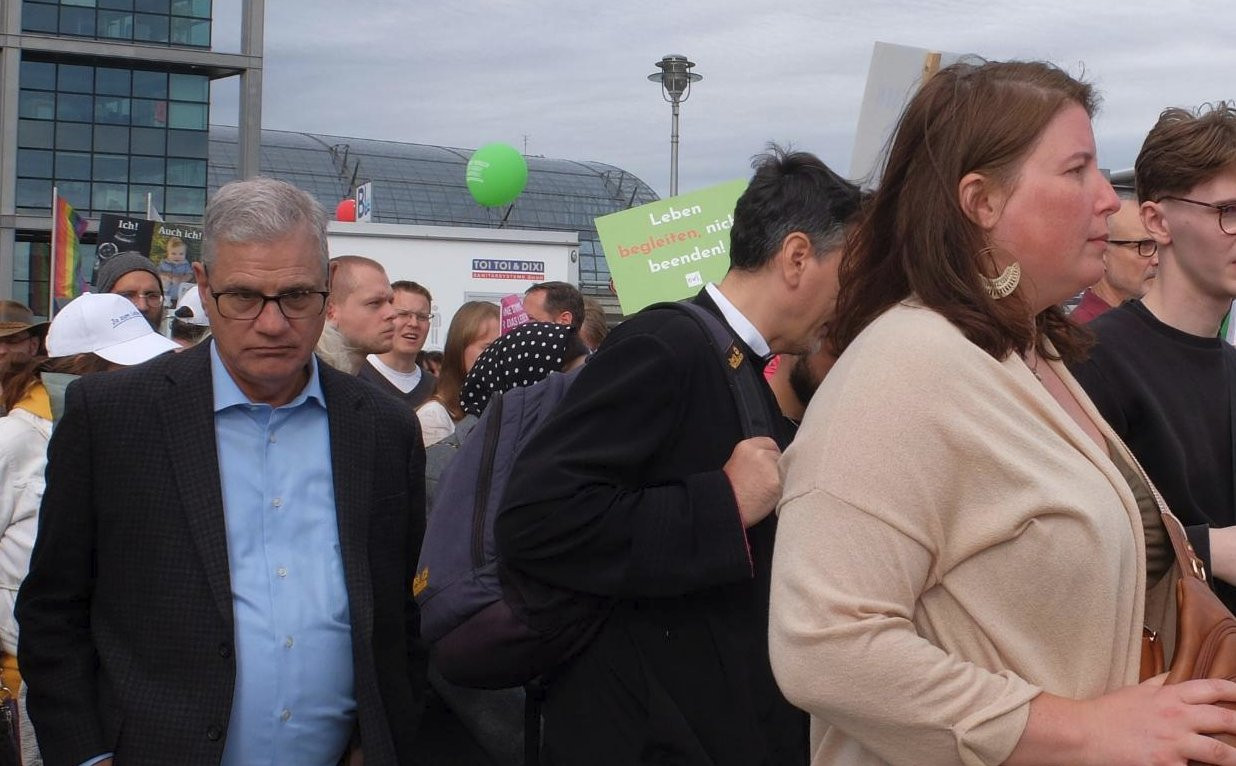
As always, the counter-protests were clearly visible and audible. This year, however, a particularly large police presence prevented them from engaging in direct confrontation with the anti-abortion activists. Several hundred people took part in rallies and protests in both cities; the events were organized by, among others, the “What The Fuck?!” alliance, the Alliance for Sexual Self-Determination, Doctors for Choice, and several other groups. It is largely thanks to the counter-demonstrations—which have been taking place since 2009—that the reactionary rhetoric of the “pro-life” movement is also addressed in critical media coverage and that key figures in politics, the church, and society are maintaining the necessary distance from it. As bizarre and outdated as Christian fundamentalists may seem—the movement’s problematic, anti-feminist messages and its overlaps with anti-democratic circles should not be allowed to go unchallenged on the streets or on the big stage.
Quiet Professionalization and Better Networking
Yet away from the large anti-choice marches, a troubling development is taking place: the rapidly advancing professionalization and internationalization of the movement is now bearing fruit. For example, this year’s march was accompanied by a meeting in Berlin of the anti-choice network Heartbeat International. Jor-El Godsey, president of Heartbeat International, appeared as a prominent speaker at the march. At the internal meeting, several dozen (presumed) counselors and activists from several European countries networked with one another. The organization is a Christian network of anti-abortion groups founded in the U.S. in 1979 that operates so-called “Crisis Pregnancy Centers.” Contrary to what the name suggests, these facilities do not offer serious support to pregnant women in crisis. Rather, they attempt to pressure women with unwanted pregnancies—through psychological pressure and the dissemination of medical misinformation—into continuing their pregnancies at all costs. The Heartbeat Network supports these facilities with legal expertise and training for staff. In Germany, too, there have been and continue to be facilities that suggest they provide reputable pregnancy conflict counseling—but in reality, they neither offer unbiased counseling nor issue the counseling certificate required for a legally permissible abortion.
The organizations that run these counseling centers in Germany—ALfA with its “VitaL” counseling hotline, KALEB e. V., and Profemina International GmbH Sozialunternehmen—are also represented at the marches with information booths and are, in some cases, affiliated with the BVL. Profemina operates its own online magazine, corrigenda, whose target audience extends far beyond its own movement into the New Right. Profemina’s managing director, Kristijan Aufiero, has already been invited twice by the AfD parliamentary group to the Bundestag as an expert witness: in 2025 to the Legal Affairs Committee and in April 2026 to the Health Committee to discuss the availability of abortion services.
Profemina vs. pro familia?
The AfD recently caused a stir with a motion in the Bundestag: The German Bundestag should call on the federal government to “immediately cease current and future payments to pro familia [the leading professional association on sexuality and partnership in Germany, member of the International Planned Parenthood Federation, E.S.] for the purpose of pregnancy conflict counseling,” because “according to its own program and statements, this organization does not possess the fundamental stance required by the Federal Constitutional Court to ensure counseling that protects unborn life.” As evidence, the motion cites three unverifiable personal accounts from alleged former clients of pro familia, which were reportedly received by Profemina—the organization led by Kristijan Aufiero.
It is concerning that these anti-abortion counseling centers—which do not act in a non-directive manner in the best interests of those seeking counseling and do not issue the counseling referral forms required by law—are now networking and providing continuing education across state lines through Heartbeat International. Especially in the context of the global rise of the far right and the AfD’s election victories in Saxony-Anhalt and Mecklenburg-Western Pomerania, we must look closely when the AfD presents itself as part of the “pro-life” movement and curries favor with it as its parliamentary arm. The fact that participation in the marches continues to decline and that churches—even within their own ranks—are taking an increasingly clear stand against the far right can only provide temporary comfort in the face of the troubling successes of the “pro-life” movement and its parliamentary advocates.
This article was first published online by the GeN - Gen-ethisches Netzwerk (Gene-ethics network) in German language. Thanks to GeN and author Eike Sanders for the permission to re-publish.
Translation by ReGA.
Redaktion: Ulli Jentsch